
Raydenwaller

Raydenwaller
- Członek od: 06 Nov 2026
Coloring pages to explore: Notice a detail and follow your interest
You chose a drawing, but the whole picture may still feel like too much to decide at once. A visible detail can offer a smaller point of entry: a curved leaf, a window, or one shape repeated nearby. That approach works whether you begin with a printed sheet or choose from coloring pages pdf resources for a quiet activity. Notice something you want to use, then connect that observation to a first coloring choice. You do not need a story, a challenge, or a correct interpretation. After beginning, you can follow another feature, change direction, or stay with the same area while it interests you.
1. Find a starting detail in coloring pages
Look for something you can point to. An ordinary description is enough.
1.1 Name a visible feature in ordinary words
On a hypothetical garden drawing, you might notice a curved leaf beside a straight stem. In a house scene, a small window or its frame might catch your eye. A repeated design may offer several versions of one enclosed shape. Name the feature simply: a curve, a window, or a row of shapes.
You do not need to know why the artist included it. The observation gives you one part of the picture to engage with.
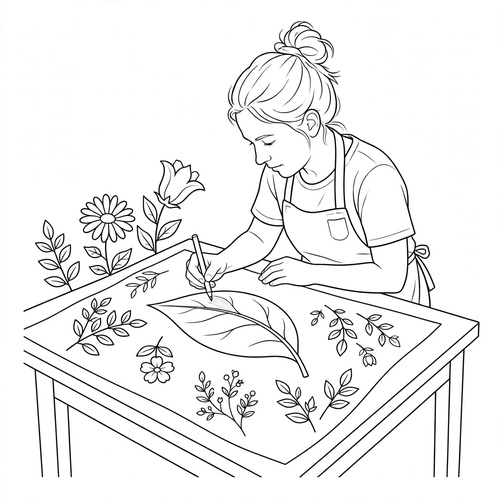
Person focusing on curved leaf in large garden drawing
1.2 Choose a feature that interests you personally
Choose the feature because it interests you, not because you assume it is the intended focal point. A small object near the edge can be as useful as the central subject. You might like its outline, the space inside it, or its position beside something else.
Those reasons are enough to give you a wanted action.
2. Turn the detail into a first coloring choice
Turn the feature you noticed into an area you want to color without deciding the sequence of the whole sheet.
2.1 Begin with the area that drew your attention
If the curved leaf caught your attention, begin with that leaf. If the window interested you, choose its frame or one enclosed part. Noticing has now led to an action on the drawing.
The same principle applies when you are choosing among free coloring sheets: you do not have to assess every element before starting. One appealing shape can be enough. You do not need a particular color, a realistic result, or a special technique. The first choice answers where you want to engage.
A simple way to keep that choice manageable is to notice:
● one shape that attracts your eye;
● one enclosed area that feels comfortable to start;
● one nearby feature you may explore later;
● one place you are happy to leave untouched.

Child coloring house window then following flower box
2.2 Keep surrounding spaces available rather than assigned
The neighboring stem, the wall around the window, or the next repeated shape can remain available. Beginning in one place does not commit you to tracing every contour outward or finishing a sequence.
You may move to a distant object or stop with that detail partly colored. The surroundings can remain open.
3. Choose a route through the picture
A route can follow visible relationships such as proximity or repetition. It can also change when another area interests you more. This can be useful with free coloring pages to print, where a drawing may offer several possible paths rather than one fixed order.
3.1 Follow a neighboring feature when it appeals
After working on a leaf, look at the nearby stem or another leaf beside it. If that neighboring feature appeals, it can become your next area. If it does not, there is no reason to follow it only because it is closest.
Let the visible arrangement suggest a possibility, then decide whether you want it. This keeps the connection concrete without turning it into a rule.
One afternoon, someone began with a small window on a house page because its frame was the first shape that caught their attention. After coloring it, they noticed a flower box, then skipped to the roof instead of continuing down the wall. The route changed because their interest changed. The picture simply offered another place they wanted to use.
3.2 Look for a repeated feature or change direction
Another route is to notice a similar shape elsewhere. A curved leaf may lead to another leaf, or one window to a different window. You can choose that repeated feature without searching for every example.
There is no timed search, required total, or correct order. You may also choose an unrelated area because it now appeals more. A neighboring move, a repeated shape, and an intentional jump can all belong to the same activity.

Person at desk choosing among three printable sheets
Useful Reference:
Printable Coloring Pages For Calm Play And Creative Confidence
Coloring Pages For Free That Turn Simple Moments Into Happy Art
4. Handle a drawing that gives you little to follow
Some drawings contain one simple subject and little surrounding detail. Work with what is visible without expecting a long chain of discoveries.
4.1 Stay with a simple subject without inventing detail
A single object can still offer a curve, an edge, or an enclosed area worth your attention. You might stay with that part instead of searching for a more elaborate relationship. A simple outline does not need a deeper meaning to be usable.
If the same small feature remains interesting, keep working there. There is no need to add imagined objects, interpret a symbol, or explain what the artist meant.
4.2 Pause the activity if observation stops helping
If close observation stops helping you color, leave that mode behind. You can return to ordinary coloring, pause the sheet, or choose another action. After noticing a window, for example, you may simply enjoy working on the surrounding house without naming more features.
Nothing requires you to explain the route you took. If no area appeals, a pause is valid. Noticing was meant to help you enter and move through the picture, not become another obligation.
5. Look for a resource at ColoringPagesCreative
At ColoringPagesCreative, you can browse coloring pages through the homepage's collections and discovery sections. Look for visible shapes or objects that you would like to explore through coloring. One interesting detail can give you a place to begin without settling the whole activity in advance.
Open the individual resource and look at the actual drawing before you begin. Check the available format, any paper guidance, and the use details for your intended activity before you download or print.
5.1 Choose visible features you want to explore
Inspect the actual image at a useful size so you can see the shapes you are choosing. A clear object with several enclosed areas may offer an immediate point of entry; a scene may offer visible neighbors to follow later.
Select features that appeal to you without assuming a collection label describes every drawing inside it. Let the visible image guide the choice.
5.2 Verify the particular drawing before use
Confirm the resource's access route, offered format, any stated paper guidance, and usage details. Match those details to what you intend to do. A preview alone does not establish a specific file type or permission for another use.
If essential information is unclear, hold that action or choose a resource with clear details. Then let the visible picture guide your first wanted choice.
6. Let the picture suggest one next action
One noticed detail can be enough for the next action. Use the connection while it helps and leave it when your interest changes. The whole sheet remains available.
Choose one visible detail in the coloring pages you want to use. Begin there if it interests you, then follow a nearby feature, notice a repetition, or move elsewhere. The route does not need to be planned in advance. Let the next action remain yours to choose.
Detale
| Płeć | Męska |
| Adres | 136 Spring St Soho, New York |

Cleveran - znajdź pracę w IT jako programista i nie tylko.